

Finance | Service Design | B2B | Workplace Innovation
Imagining the Future of Workplace Experience
Client
Commonwealth Bank of Australia
Timeline
9 months
Role
Service Design Lead
Overview & Challenge
Led a transformative research and design initiative to reimagine the workplace experience for Commonwealth Bank's 10,000 employees. Through extensive ethnographic research, behavioral archetype development, and collaborative design, we needed to create a comprehensive vision that balanced technological innovation with human-centered environments.
Key Challenges
- Address increasing demand for flexibility and mobility among employees
- Create environments that supported diverse working styles and preferences
- Balance standardization with personalization in a 10,000-person organization
- Move beyond a focus on physical architecture to a holistic experience design
- Develop spaces that would adapt to rapidly evolving technology and work practices
My Approach & Contribution
As Experience Design Director, I led a team of five senior Human-Centered Design experts through a comprehensive process that placed employees at the center of workplace transformation. Our team approached this project with exceptional dedication—not only was it a showcase for applying HCD principles to organisational contexts, but it directly affected our own working environment.
What I did
1. Directed extensive ethnographic research, including observation safaris with teams as they navigated their day-to-day work
3. Identified 26 key "Jobs-to-be-Done" that employees needed to accomplish in their workday
5. Ran 18 co-design ideation sessions with employees, generating hundreds of innovative ideas
7. Created a compelling signature journey narrative visualizing the future workplace experience
2. Deployed a 10-minute quantitative survey to 1,033 Sydney-based colleagues to validate our findings
4. Created six distinct behavioral archetypes representing different employee attitudes and motivations
6. Defined seven key opportunity areas for workplace innovation


Our research revealed three strategic pillars that underpinned employees' experience of the current workplace and drove their needs for the future:
Flexible, Activity-Based Environments
Designed spaces that adapted to different work modes with movable walls and modular furniture
Technology-Enabled Mobility
Developed a vision for seamless technology integration across physical and digital environments
Human-Centered Culture
Established design principles that prioritized psychological safety and wellbeing
Results & Impact
01
Created a comprehensive workplace strategy aligned with Commonwealth Bank's organizational vision
03
Established design principles that influenced the bank's approach to workplace design
05
Positioned Commonwealth Bank as a thought leader in workplace experience
02
Developed a signature journey narrative that guided implementation planning
04
Anticipated the future of hybrid work models before they became mainstream
Key Learnings
Workplaces thrive when viewed as interconnected ecosystems. The most impactful solutions emerged when we considered the holistic relationship between physical spaces, technology infrastructure, and human behaviors rather than optimizing these elements in isolation.
Physical and digital environments should be designed as complementary forces. The boundaries between them are artificial—successful workplaces create symbiotic relationships where physical spaces enhance digital collaboration and technology responds intelligently to human needs.
Excellence requires sustainable creative processes. While our perfectionism produced outstanding work, it created unsustainable pressure. I learned to establish clearer "good enough" thresholds earlier in projects, preserving both team wellbeing and work quality for the long term.
Process Details (optional to read)
Observation Safari
This project was a groundbreaking new initiative that aimed to explore the lives and working experiences of employees across our organisation. Through extensive qualitative research and countless hours spent shadowing different teams as they go about their day-to-day work, we have gained an in-depth understanding of the many challenges facing our colleagues as well as what delights them and what stands in their way. Whether we are looking at emotional landscapes, routines, pain points, or unmet needs, this project has given us an unparalleled glimpse into the modern workplace and helped us craft innovative strategies for a better future.


Observation safaris has helped us get a holistic view of the current state workplace experience from different lenses. To validate and add further depth to our findings, we conducted a 10-minute quantitative survey with 1033 of our Sydney-based colleagues. We developed meaningful insights combining quantitative with qualitative data, to increase our confidence. We distilled our findings into 3 Strategic Pillars that underpin our colleagues' experience of the current workplace, as well as drive their needs for the future.
Opportunity Areas Identified
Through our process, we identified seven key opportunity areas that would transform the workplace experience:
-
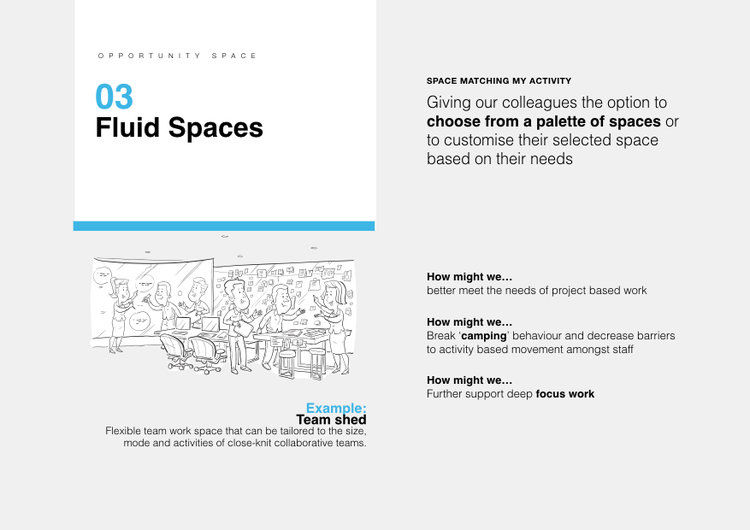
Enhanced Collaboration - Spaces and tools that facilitated both planned and spontaneous teamwork
-
Focus Zones - Dedicated environments for deep, concentrated work
-
Learning Landscapes - Integrated learning opportunities throughout the physical environment
-
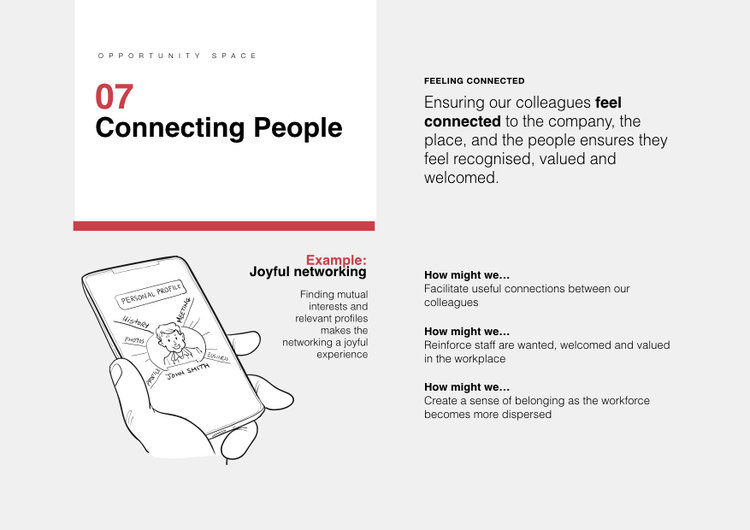
Community Building - Spaces that fostered connection and organizational culture
-
Wellbeing Integration - Design that supported physical and mental health
-
Technology Harmony - Seamless integration of digital and physical experiences
-
Personalisation at Scale - Systems that adapted to individual preferences while maintaining coherence

Jobs to be done
Using the jobs-to-be-done (JTBD) framework, we gained a deep understanding of employees' tasks, activities, and intents to perform their day-to-day jobs. The aim of this framework was to focus on the functional, social, and emotional dimensions that underpinned what employees needed in order to excel in their roles. This approach helped us to identify the ideal work environment and culture that would allow each employee to be at their best.
Over the course of co-design sessions with our target employees, we explored a range of possibilities for improving their work experience and culture. Together, we brainstormed potential solutions for issues like workflow management, effective communication and collaboration, and motivation. Through these sessions, we were able to gain a deeper understanding of what each employee valued most about their job, as well as the aspects that were getting in the way of their success. Overall, the JTBD framework proved to be an invaluable tool for gaining insights into how our employees perceived their work experience and helped us create spaces that would facilitate their optimal performance.


JTBD also helped us to ideate and co-design with our colleagues to design the optimum work environment and culture, so they can be their best. Across the 18 ideation sessions, our colleagues created 100s of ideas, and more importantly, we observed similar ideas generated multiple times. We combined the ideas based on similarity, and they evolved into our key concepts.
Behavioural Archetypes
When it comes to understanding and approaching the diverse needs and behaviours of today's workforce, traditional methods just aren't cutting it. After analysing thousands of employee interactions and pain points, we identified six distinct archetypes that represent a wide range of employee attitudes and motivations. Using this approach, we were able to gain a better understanding of the overlaps and differences among such a diverse and broad group of individuals.


We also defined each archetype's working modes, movement patterns, and interaction styles, which helped inform our approach to space design and workplace experiences. By identifying these different behaviours and tailoring our designs accordingly, we are able to create spaces that truly meet the needs of all employees and help them succeed in today's fast-paced work environment. Whether you're a highly driven go-getter or a meticulous perfectionist who likes to take things slow, there's something for everyone in our approach to workplace design.
Co-designing
Over the course of the second stage of our workplace design project, we engaged in a series of workshops and ideation sessions to gain a deeper understanding of the needs and desires of our colleagues. During this process, we carefully considered all of the insights gained from our initial research, in order to create truly innovative concepts that would meet the needs of our team members. Through these collaborative efforts, we were able to come up with hundreds of ideas for the future workplace.
The key concepts that emerged from these sessions reflect both our expert knowledge and expertise as well as the lived experiences and ideas of the people who will ultimately be using the space on a daily basis. In other words, these concepts arise from both an academic understanding of what makes an ideal workspace and some truly brilliant blue-sky thinking from our talented team members. Whether it's fostering collaboration or ensuring optimum productivity levels, we are confident that these key concepts will help to create a truly transformative experience for all those involved.


The future state journeys
With Experience Concepts as guides, this workshop invited a core team of property, interior designers and 40 employees to reimagine the customer journey from start to finish. Participants were divided into six teams, each representing a different behavioural archetype, and tasked with designing the ideal customer journey for their archetype.
After coming up with a range of potential ideas, the teams then collaborated to create distinct future journeys that were tailored specifically to their individual archetypes. Ultimately, this workshop was an inspiring and engaging opportunity for all involved as they worked together towards redefining customer expectations and experiences for the future.
Taking it all in from the workshops, we created a signature journey – presenting a day in the life of one of their employees from the perspective of an outsider observing them at work. This unique take allowed us to craft a compelling narrative around their vision that combined storytelling with animated sketch notes, bringing our ideas vividly to life.

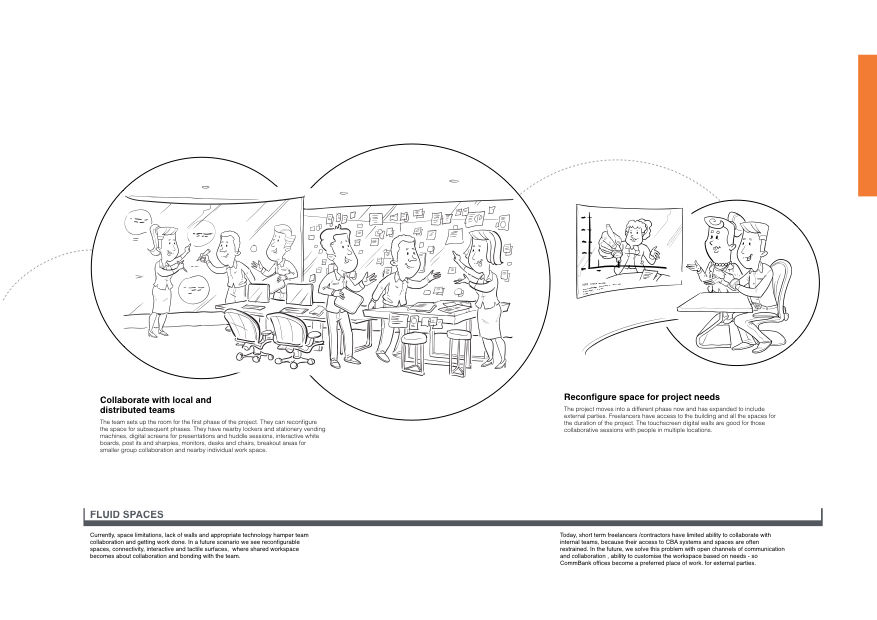
Human-centred design is a powerful methodology for designing effective and engaging workplace environments. By shifting the focus away from walls, rooms, and furniture and towards the real experiences that are created by these spaces, human-centered design has been instrumental in revolutionising workplace design. Through our deep focus on empathy, we have developed a strong foundation for refining our ideas through prototyping and testing.
Indeed, workplace design is a fertile field for experimenting with new concepts and approaches, providing us with an exciting opportunity to transform our working and living spaces. Whether we're designing workspaces for companies or public spaces like libraries or hospitals, human-centered design provides us with a powerful toolkit for crafting effective and engaging environments. So let's embrace this opportunity to think creatively about how we can shape the places where we live, work, play, and learn