

Retail & Hospitality | Experience Design | B2C | Service Innovation
Optimizing Fast Food Ordering Experience
Client
Guzman Y Gomez
Timeline
3 months
Role
Experience Designer
Overview & Challenge
Guzman Y Gomez (GYG), a chain of Mexican Taquerias (fast food shops), approached us with a challenge: they were planning to open a new shop in one of Sydney's busiest lunchtime food courts and wanted to ensure the food ordering experience was quick and smooth enough to remove long queues and increase sales. They needed to speed up the food ordering process without losing their food concept and company values (without becoming "McGomez").
Key Challenges
- Long ordering times, particularly for new customers unfamiliar with Mexican cuisine
- Multiple decision points creating customer paralysis at the counter
- Inefficient customer flow creating bottlenecks during peak periods
- Lack of visual information on menu boards making choices difficult
- Need to maintain authentic food experience while improving efficiency
- Limited space in the food court location for queuing customers
My Approach & Contribution
I applied experience modelling techniques to understand and redesign the customer journey, focusing on both the ordering process and physical flow through the space.
Key Activities
1. Conducted field studies including competitor observations and analyses in busy food courts
3. Performed contextual enquiries to understand customer approaches to ordering
5. Identified distinct customer types: "Newbies" (taking 2.5-5 minutes to order) and "Regulars" (30 seconds)
7. Created a new layout encouraging cyclic flow to reduce congestion
2. Interviewed GYG staff to understand their expertise and customer interaction patterns
4. Analysed CCTV footage to map current customer flow patterns
6. Introduced the "Trusted Advisor" concept into the menu design
8. Tested designs with real customers during peak hours
The key insight from our contextual inquiries was that too many decision points paralysed customers, and they had limited understanding of their choices. This was partly due to lack of visuals on the menu and lack of knowledge about Mexican food ingredients. We observed that staff compensated for the menu by helping customers choose and speed up the ordering process, indicating that staff expertise needed to be incorporated into the menu design.
Results & Impact
01
Reduced average ordering and queuing time by fifty percent
03
Increased lunchtime sales by six times compared to previous locations
05
-Enabled the restaurant to sell over 250 burritos in an hour
02
Significantly enhanced customer flow through the redesigned space
04
Successfully launched the new experience model across multiple stores
The work done by Dr. Bilda and the team has dramatically changed and financially improved our business. Guzman y Gomez was re-introducing Mexican cuisine to the Australian public, but was having one major problem...most Australians didn’t understand what we were selling! Ordering times were high due to the number of questions requiring additional information. Through their behavioural research and analysis of customers, Different constructed new menu boards which we call the “GyG trusted Advisor”. Ordering times decreased by over 70%..amazing! It enabled us to sell over 250 burritos in an hour. Besides the incredible results delivered, it was a pleasure to work with such a professional and passionate team.
Steven Marks, Founder and MD, GYG
.png)
Service Design Methodology
Key Learnings
Good service design directly impacts the bottom line. By fixing both how information was presented on menus and how people moved through the space, we made the restaurant much more efficient without losing what made it special.
Less choice often leads to better decisions. Instead of adding more options, we simplified the menu based on what staff would actually recommend. This "trusted advisor" approach helped customers feel confident while choosing faster.
Real-world testing beats theoretical ideas every time. By putting a full-size menu prototype in the actual restaurant during busy hours, we proved our concept worked under pressure and gave everyone confidence before making permanent changes.
Deep Dive Design Process
Service safaris
We conducted field studies including competitor observations and analyses, GYG staff interviews, contextual enquiries, customer observations, interviews and behavioural analyses. The analyses and findings from these different research methods enabled us to come up with an experience-model to achieve a smooth and quick ordering/eating experience.
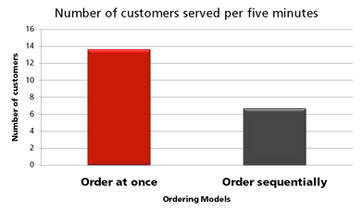
The competitors' service analysis was done in a busy food court in CBD in lunchtimes over two days and involved time tracking and structured observations. The objective was to understand how similar businesses operate and which customer service models they own. Next step was to set the research/ benchmark criteria for the whole project and compare competitors' service models to GYG. As a result, we identified the quickest ordering time, customer flow rates and the best customer task model that suits GYG.
.png)
Competitor service models
.png)
Benchmarking service models
Behavioural insights
We conducted brief contextual inquiries in-store to understand customers' approach to ordering and to explore their attitudes and social interactions. The key insight was that too many decision points paralysed the customer and they had no understanding of their choices. This was partly due to lack of visuals on the menu and lack of knowledge on base ingredients of Mexican food. We also observed that the staff compensated for the menu by helping customers choose and speed up the ordering process. It became obvious that staff expertise had to be incorporated into the menu.
At the end of contextual inquiries, we identified two types of customers: Newbies and Regulars. Regulars knew about the food and knew what to order. They could order as short as 30 seconds, however for newbies, it was taking a lot more time 2 and a half to 5 minutes. Once again this insight confirmed the need to guide customers more instead of providing all choices.
.png)
Contextual inquries
.jpeg)
Ordering flows - newbie and a regular customer
We have used the long hours of recording on the CCTV cameras to define current customer flow in the store and other perceptual factors that affect food ordering. We have also tracked how customers repeatedly move in the store from entry to collecting their food and created customer flow maps to illustrate the flow problem.
.png)
Video monitoring in store
.png)
Customer flow map
Prototyping
We introduced the "Trusted Advisor" into the menu as opposed to the Do-It-Yourself model. To simplfy the menu we asked the staff what they would naturally recommend to the customers. Based on their expertise we have come up with 6 main products to choose from - supported with pictures to communicate what the food looks like (this was key as most people did not know what a burrito or a taco looked like with fillings). Customers can quickly order one of the items with a photo - and this saves a lot of time in majority of the cases.
.png)
Menu priority areas

Menu redesign
In terms of spatio- temporal design, I proposed a new layout that encourages a cyclic flow and takes the load off from queuing spots. In order to further regulate the customer flow, I nominated a single delivery point and specific areas for queuing and waiting spots where customers may learn more about Mexican food. Customer flow maps before and after the design show the dramatic flow improvements in the store.
.jpeg)
Customer flow map before redesign
.jpeg)
Customer flow map after redesign
Testing in-field
After making the layout changes in the store, we printed a large poster version of the new menu design and hung it over the existing menu board at a peak hour - and monitored customer behaviour for 3 hours. Our objective was to test customer acceptance of the new menu, measure ordering/ queuing times, and to track new customer flow. Feedback on the new menu design was mostly positive, customer flow was enhanced and the most significant change was the ordering times. As a result of our experience modelling, the average ordering and queuing time was reduced by fifty per cent. GYG launched our new experience model in several stores and on the first day of the opening they earned six times more than before.
.jpeg)
In-Store Prototype
.jpeg)
Ordering and queing times improved after redesign
.jpeg)
Sales before and after the redesign