
Telecommunications | Service Design | B2C | Digital Transformation
Telstra's Fibre Customer Journey
Client
Telstra Australia
Timeline
6 months
Role
Principal UX & Service Designer
Overview & Challenge
In this project, I was tasked with bringing to life high-level concepts for the self-service and assisted customer experience of Telstra's fibre broadband product. The company planned to transition most of their customers to the NBN (National Broadband Network) fibre broadband by 2020, requiring a new end-to-end customer and employee experience to be designed and delivered for launching the NBN product.
Key Challenges
- Creating a cohesive experience across multiple channels (online, retail, call centre, in-home)
- Designing for both self-service and assisted customer journeys
- Simplifying complex technology concepts for average consumers
- Addressing customer fears about service disruption during transition
- Coordinating frontline employee experience with the customer journey
- Reducing the time agents spent explaining the technology
My Approach & Contribution
After reviewing past research, I planned and conducted extensive fieldwork to understand the complete customer experience. I observed how agents serve customers in call centres and Telstra stores and travelled with technicians to see how they connect customers' homes.
Key Activities
1. Created NBN Personas to represent different customer types and needs
3. Developed a User Task Model informed by the 2020 experience vision
5. Designed responsive site wireframes and used quick prototyping tools to test with customers
7. Enacted switching scenarios through roleplaying with frontline agents and customers
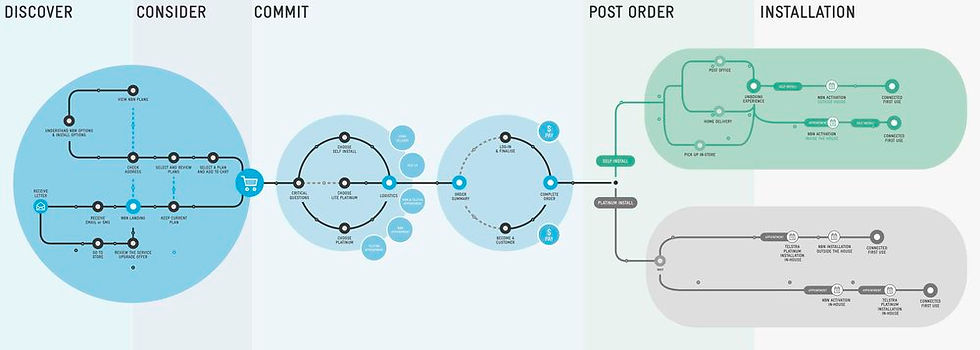
2. Defined a service blueprint for the product lifecycle across all touchpoints
4. Created storyboards describing end-to-end customer and performer experience variations
6. Redesigned agent-customer dialogues to sync with business design and online flow

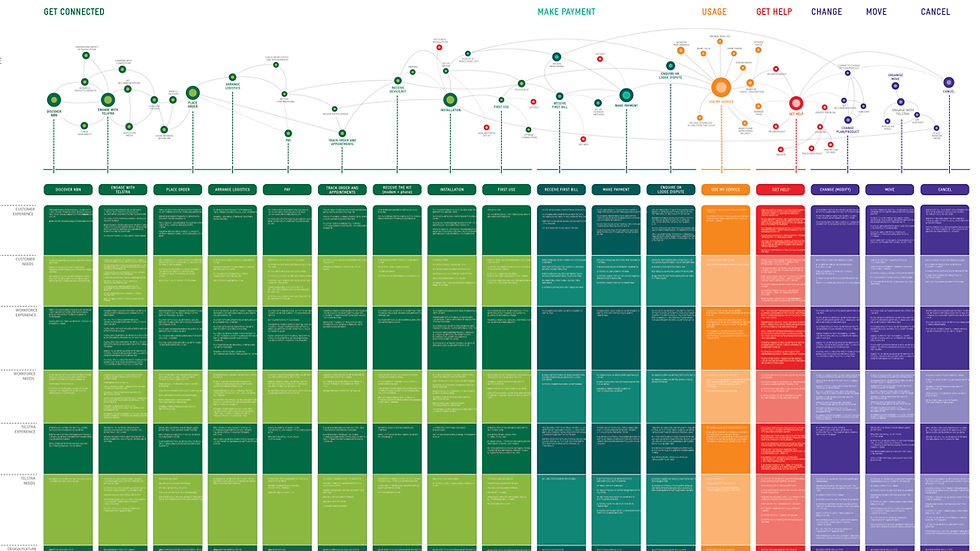
Task Model
representing the user tasks and digital features required for an end-end experience
The User Task Model became a foundation to meet customer needs and helped us standardise and track each stream's work. It served as a crucial alignment tool for business, design, and IT teams in an agile working environment.
Results & Impact
01
Created a seamless multi-channel experience spanning digital interfaces, retail stores, call centres, and in-home technician visits
03
Improved customer satisfaction during the complex transition to fibre broadband
05
Provided frontline staff with better tools and scripts to explain the complexities of the switch
02
Reduced the time spent explaining technology to customers through clearer communication tools
04
Enhanced the assisted buying experience, resulting in a definite sell in one-third of the current time spent with customers
06
Developed a cohesive experience that increased customer confidence in the transition
Key Learnings
Both sides of the counter matter equally. The best services work well for customers and staff alike - giving frontline teams the right tools directly impacts how good the customer experience can be.
Complex tech needs simple explanations and breathing room. Customers need clear information and time to absorb it, while staff need good conversation guides that help them explain complicated things without overwhelming people.
Role-playing beats traditional testing every time. By acting out real scenarios between staff and customers, we spotted issues that surveys and interviews would have missed completely, leading to practical improvements for everyone involved.


Employee experience
For the employee experience, I analysed frontline staff's current activities and found they were often limited by the systems they use. I proposed improvements to interactions, conversations, and the systems agents use, sometimes changing the order and logic of tasks, other times proposing entirely new flows or system updates.
.png)
Through in-store roleplaying tests, we found that the redesigned assisted buying experience resulted in a definite sell in one-third of the time previously required. This dramatic improvement came from giving frontline employees better tools to explain the technology and reassure customers about the changes.